
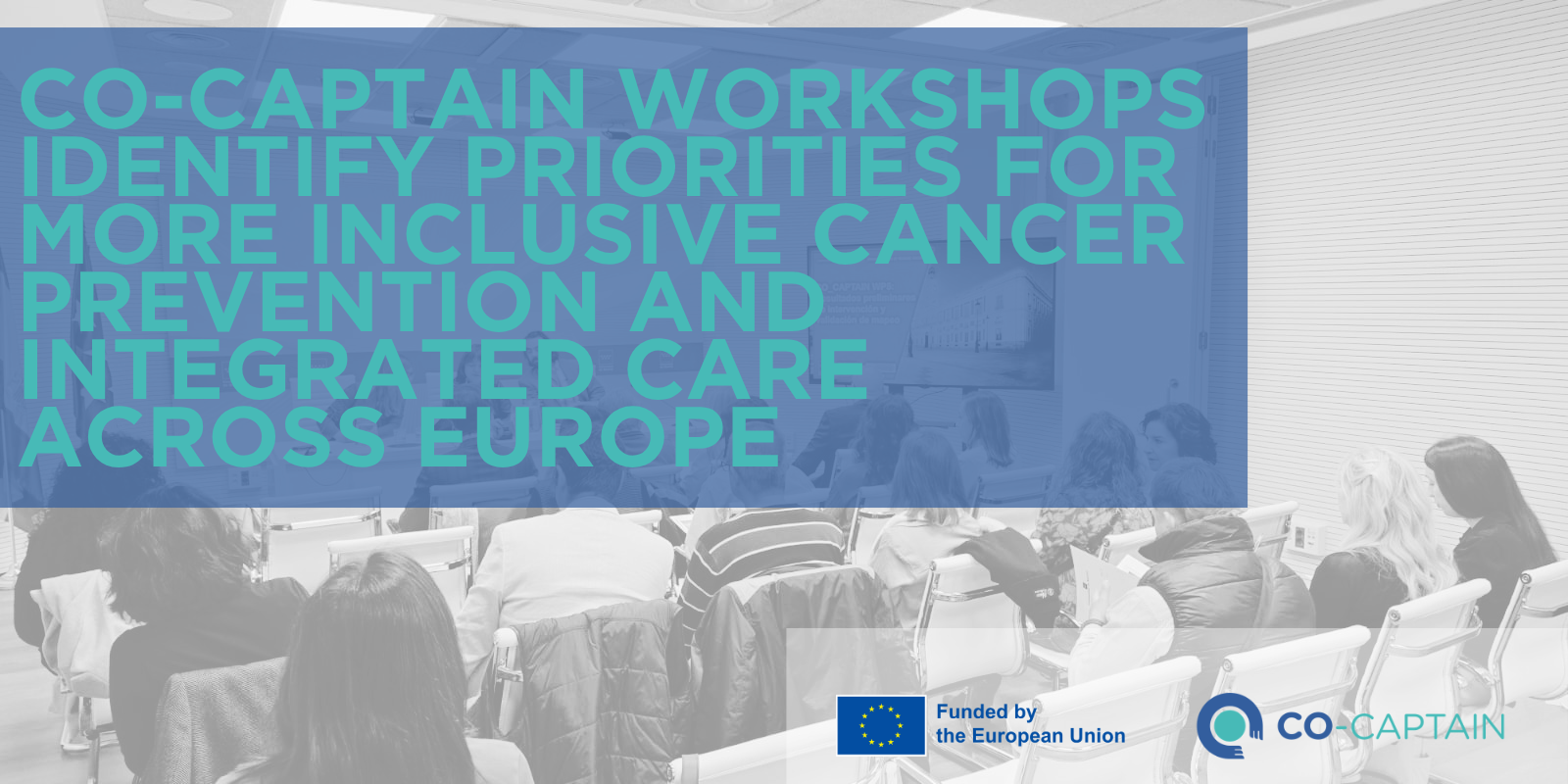
Over the past months, the CO-CAPTAIN consortium has carried out a series of multi-stakeholder workshops across the pilot countries as part of Work Package 5 (WP5), bringing together healthcare professionals, policymakers, mental health specialists, social care providers, NGOs, researchers, patient representatives and people with lived experience.
The workshops were designed to go beyond traditional consultation exercises. Their objective was to create a collaborative space where stakeholders could reflect on the real-life barriers faced by people experiencing mental ill-health in accessing cancer prevention and care, validate the Integrated Cancer Care (ICC) standards explored within the project, and jointly shape future policy and implementation recommendations.
Across Austria, Greece, Poland and Spain, discussions revealed both the complexity of integrated cancer prevention and the remarkable convergence of challenges and priorities between countries.
Workshop 1: Understanding barriers and validating integrated care needs
The first workshop phase focused on validating local service mapping, discussing the relevance of the ICC standards and identifying structural barriers affecting people with mental health conditions throughout the cancer prevention and care pathway.
One of the strongest messages emerging across all pilot countries was the persistent fragmentation between oncology, mental health, primary care and social services. Participants repeatedly highlighted that patients are often expected to navigate highly complex systems on their own, with insufficient coordination between professionals and services.
In Poland, experts described how the absence of integrated pathways between oncology and psychiatric care creates important gaps in continuity of care and early psychosocial support. Participants stressed that people experiencing mental ill-health frequently encounter difficulties in accessing coordinated services, while older adults face additional barriers related to stigma, isolation and digital exclusion.
Similarly, discussions in Greece underlined that identifying available services is not enough if patients struggle to access them in practice. Stakeholders highlighted bottlenecks in referrals, limited psychosocial support and the importance of ensuring therapeutic continuity throughout the cancer pathway.
In Austria, participants pointed to the need for stronger multidisciplinary collaboration and recognised that fragmentation within healthcare structures can hinder coordinated care. Discussions also highlighted the importance of integrating mental health perspectives into oncology settings and improving communication between hospital and outpatient services.
Despite differences in healthcare systems, stakeholders across countries shared a common conclusion: integrated cancer prevention requires more than isolated interventions. It requires coordinated pathways, better communication between sectors and more person-centred approaches capable of responding to people’s social, psychological and practical needs.
Another major topic throughout the first workshops was the role of the Patient Navigator.
Participants consistently recognised that navigation support can help reduce barriers related to communication, healthcare bureaucracy, anxiety, lack of information and fragmented care pathways. In Greece, stakeholders described the relational aspect of navigation as one of its most valuable contributions, noting that many participants experiencing cancer and mental health problems often feel lonely and unsupported.
In Poland, workshop participants highlighted how the navigation model improved continuity, engagement and trust, particularly within community-based support settings. Stakeholders emphasised that the success of the model depended largely on the navigator being perceived as part of the therapeutic team rather than as an external actor.
The discussions also highlighted the importance of adapting prevention approaches to different population groups. Stakeholders repeatedly warned that digital-only solutions risk increasing exclusion among older adults and vulnerable populations, reinforcing the need for accessible, flexible and human-centred services.
Workshop 2: Co-developing policy recommendations
Building on the findings from the first phase, the second round of workshops focused on the development of policy recommendations aimed at supporting the long-term implementation and scalability of integrated cancer prevention approaches.
Across the pilot countries, participants agreed that stronger coordination frameworks are urgently needed to connect oncology, mental health, primary care and social support systems.
In Greece, stakeholders identified the need for national action plans, stronger local coordination mechanisms and clearer continuity pathways for follow-ups and referrals. Participants also stressed the importance of developing support structures for caregivers and families, as well as educational and training programmes for Patient Navigators.
A recurring recommendation across countries was the formal recognition and integration of the Patient Navigator role within healthcare systems. Participants argued that navigation should not depend on temporary project-based structures, but rather become a stable and sustainable component of integrated care pathways.
Workforce development and professional training also emerged as key priorities. Stakeholders highlighted the need for additional training in mental health, communication, psychosocial support and interdisciplinary collaboration, particularly for professionals working in oncology settings.
In Austria, workshop discussions explored the possibility of incorporating psychiatric modules into oncology training in order to reduce diagnostic overshadowing and improve the capacity of professionals to respond to the needs of people experiencing mental ill-health.
Participants also stressed the importance of co-design and participatory approaches. Several workshops highlighted that people with lived experience, caregivers and patient advocates should play a much stronger role in shaping healthcare services, communication materials and shared decision-making processes.
Digitalisation was another central topic.
Stakeholders acknowledged the potential of interoperable digital systems to improve continuity of care, reduce redundant documentation and facilitate information sharing across services. However, they also warned about the risks associated with fragmented digital infrastructures, lack of interoperability and concerns around confidentiality and stigma.
In Austria, discussions focused on the need for better digital pathways capable of linking mental health and cancer care information while preserving patient consent and data protection. Participants also stressed that digital tools should complement — not replace — personal interaction and human support.
Workshop 3: From recommendations to implementation
The third workshop phase focused on validating the draft recommendations, assessing feasibility and discussing the governance, financing and implementation conditions needed for future uptake.
One of the clearest conclusions from these discussions was that many of the proposed changes are not only desirable, but long overdue.
Participants stressed that successful implementation will require action at multiple levels simultaneously: healthcare organisations, regional authorities, ministries, professional associations, insurers and community actors all have a role to play.
In Austria, stakeholders discussed the importance of creating sustainable funding mechanisms for multidisciplinary collaboration, case management and activities that do not involve direct patient contact, such as interdisciplinary meetings and coordination work. Participants noted that many essential integrated care activities remain invisible within current reimbursement systems.
The workshops also highlighted the need for clearer governance structures and better definition of professional roles. Discussions explored how navigators, case managers, psycho-oncologists, nurses and peer workers could collaborate more effectively within integrated cancer care pathways.
Importantly, stakeholders repeatedly emphasised that implementation should build on existing structures and initiatives whenever possible. Rather than creating entirely new systems, participants advocated for strengthening coordination, improving communication and expanding successful practices already operating locally.
Across the workshops, participants also underlined the importance of flexibility. Different healthcare systems, organisational cultures and local realities require adaptive approaches rather than rigid models.